
Visitors wandering through Kathmandu Valley often experience a moment of double-take. One minute they are admiring intricately carved wooden struts supporting centuries-old temples; the next, they notice that some of those carvings depict people engaged in activities that would probably get an Instagram account suspended. For many first-time visitors, the immediate assumption is that they have stumbled upon “Kamasutra temples”. But the reality behind Nepal’s erotic temple carvings is considerably more complex and far more interesting than simply reducing them to ancient pornography.
Table of Contents
First things first: they are not actually “Kamasutra Temples”
Scattered throughout Kathmandu, Bhaktapur, Patan and numerous smaller towns, these erotic sculptures form part of a long tradition of religious and artistic expression that has puzzled scholars, embarrassed colonial-era observers, amused tourists, and remained largely uncontroversial among local communities for centuries.
One of the biggest misconceptions is that Nepal contains temples specifically dedicated to the Kamasutra. It does not. The Kamasutra itself is an ancient Sanskrit text written by Vātsyāyana around the 3rd to 5th century CE. Despite its modern reputation, the text is not simply a manual of sexual positions. It discusses relationships, courtship, marriage, social conduct, and the role of pleasure within human life.
The erotic carvings found on Nepalese temples are not direct illustrations from the Kamasutra. In fact, there is little evidence that the artisans who created these sculptures intended them as references to the text at all. The term “Kamasutra temples” is essentially a modern tourism label applied to temples containing erotic imagery. It is catchy, easy to market, and technically inaccurate.
This places Nepal in similar company to India’s famous temples at Khajuraho and Konark, which are likewise often branded as “Kamasutra temples” despite having much broader artistic and religious significance.
Where can you find erotic temple carvings in Nepal?
The highest concentration of erotic carvings can be found throughout the Kathmandu Valley, particularly in areas associated with traditional Newar architecture. Some of the most notable examples include:
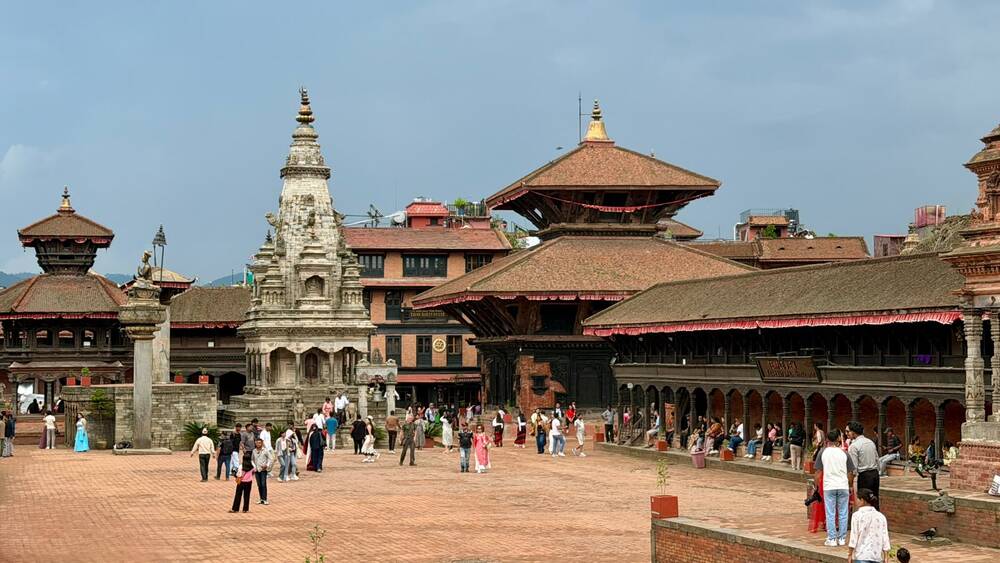
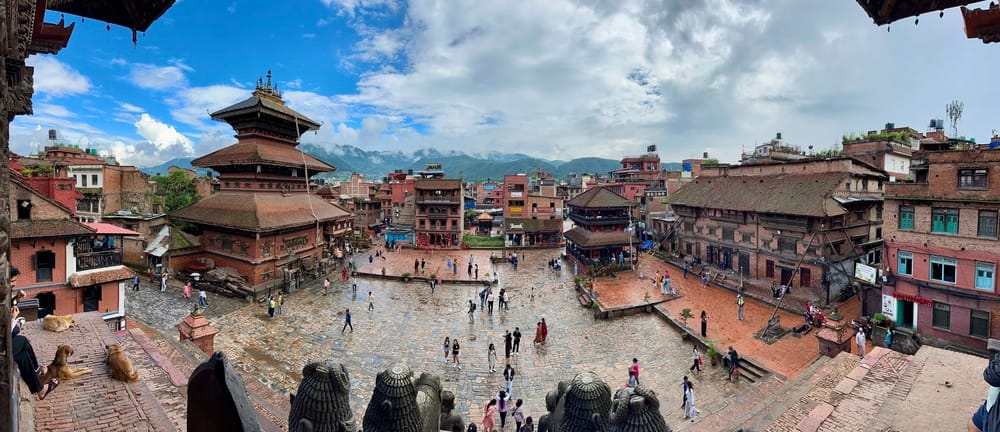
Bhaktapur Durbar Square
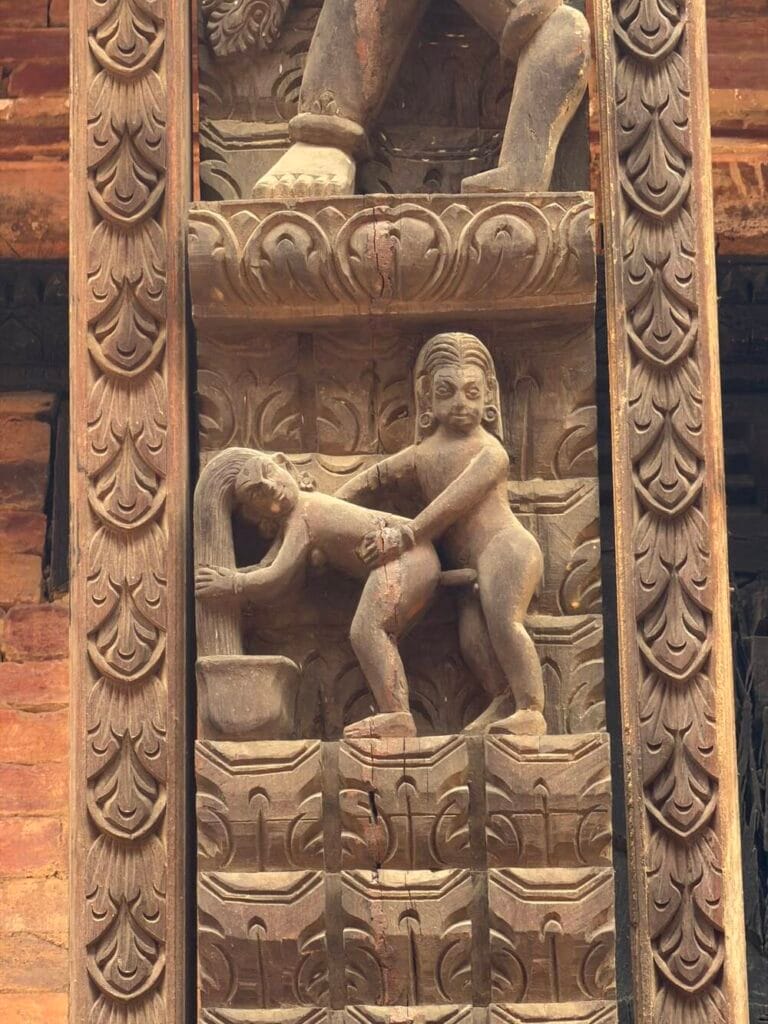
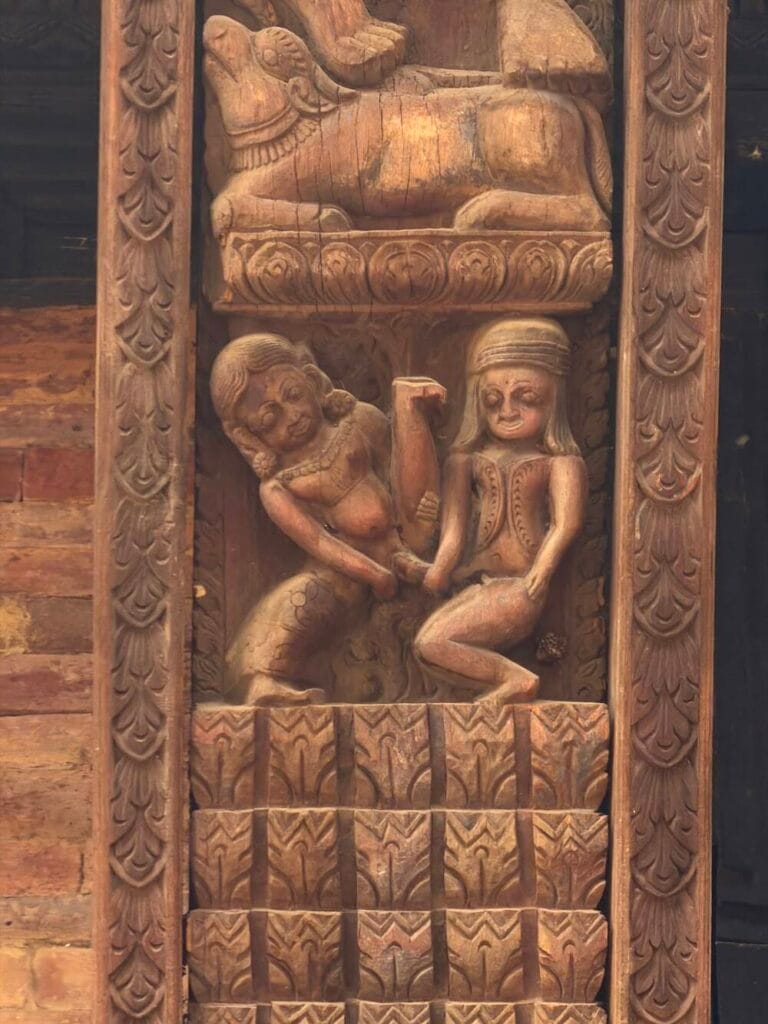
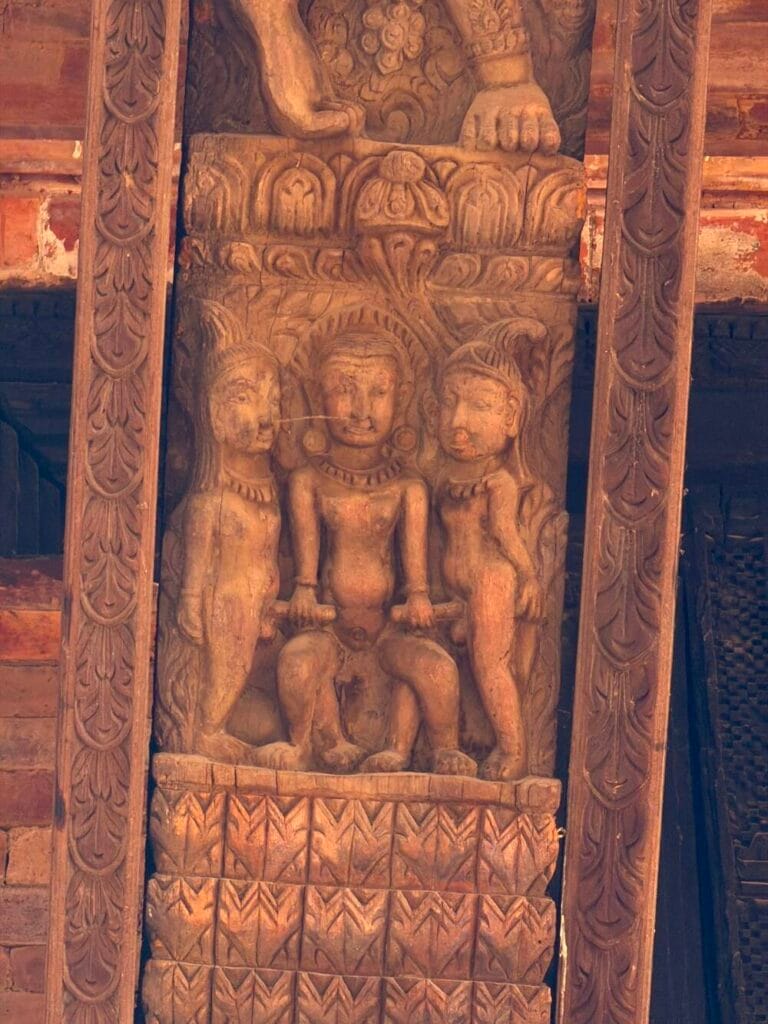
Bhaktapur contains some of Nepal’s finest surviving examples of medieval architecture. Among its many temples, visitors will find numerous carved wooden struts depicting erotic scenes.
The carvings are often positioned beneath roof overhangs where they can easily escape notice unless someone points them out.
This has led to an amusing phenomenon whereby tourists spend twenty minutes photographing a temple before suddenly noticing that one of the supporting beams depicts an acrobatic sexual position that would probably require both flexibility and a medical waiver.
Nyatapola Temple
The famous five-storey Nyatapola Temple in Bhaktapur, completed in 1702 during the reign of King Bhupatindra Malla, contains examples of erotic wood carvings on supporting struts.
Interestingly, most visitors remain focused on the temple’s impressive height and monumental staircase. The carvings often become a secondary discovery.
Kathmandu Durbar Square
Several temples within Kathmandu Durbar Square display erotic imagery, although earthquake damage and reconstruction efforts have affected visibility in some areas. Many carvings remain intact and continue to attract both scholarly interest and tourist curiosity.
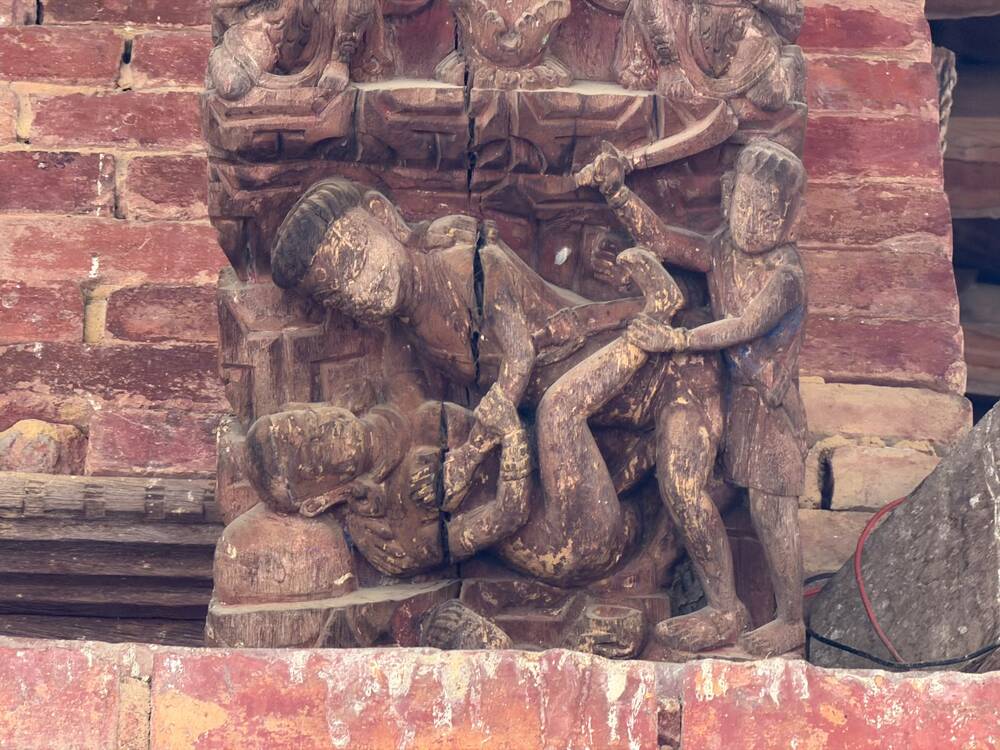
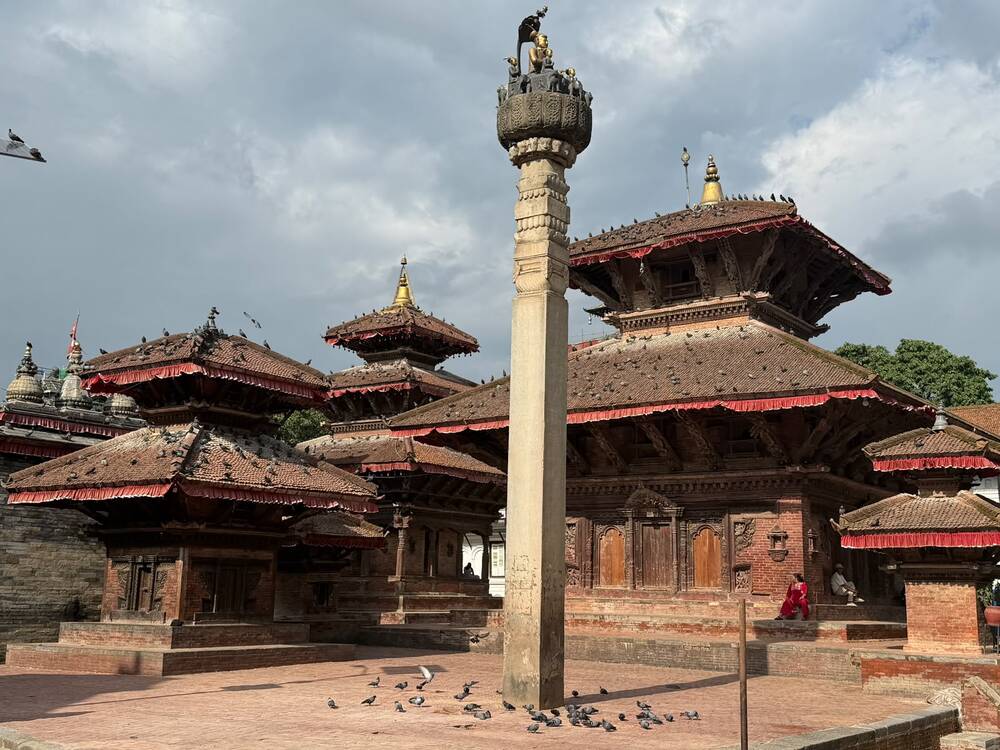
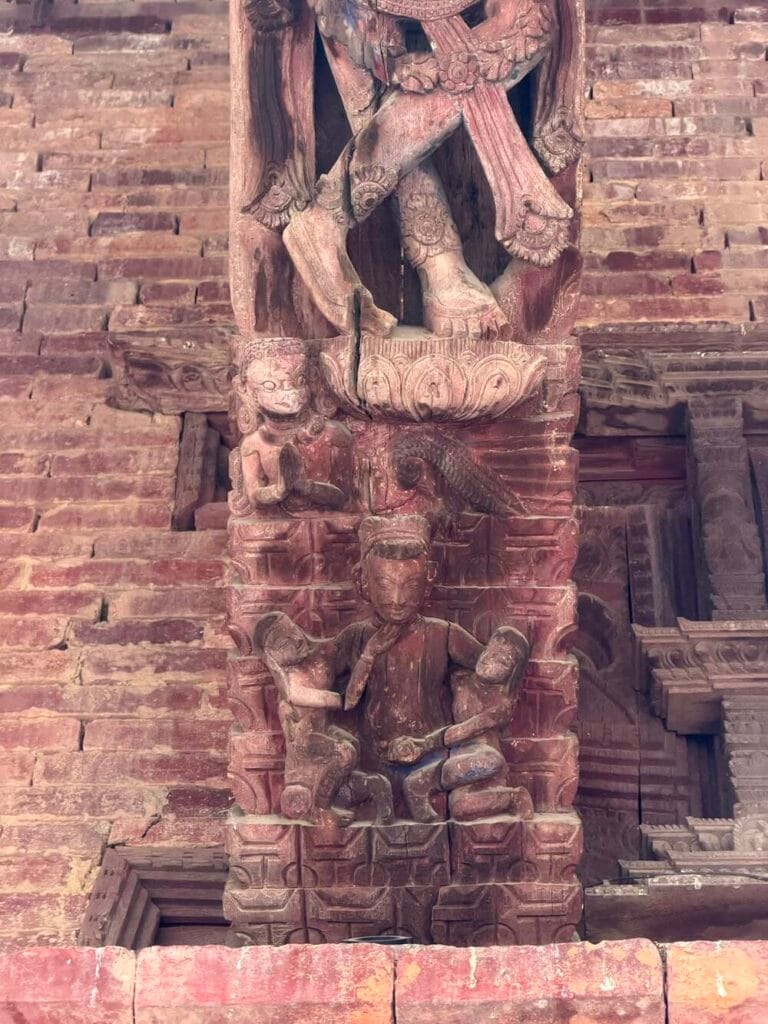
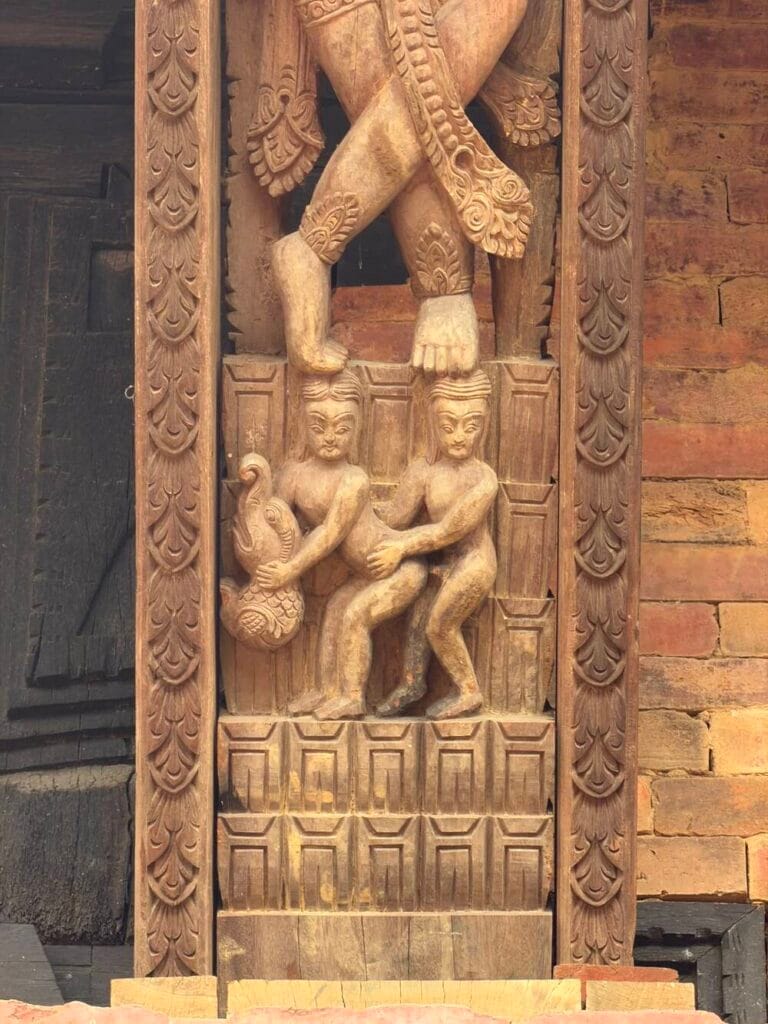
Patan Durbar Square
Patan contains some of the most refined Newar craftsmanship in Nepal. Erotic motifs appear among the vast collection of carved wooden supports, often integrated seamlessly alongside religious figures, mythical creatures, and decorative patterns.
The result is not a separate category of art but part of a broader visual language.
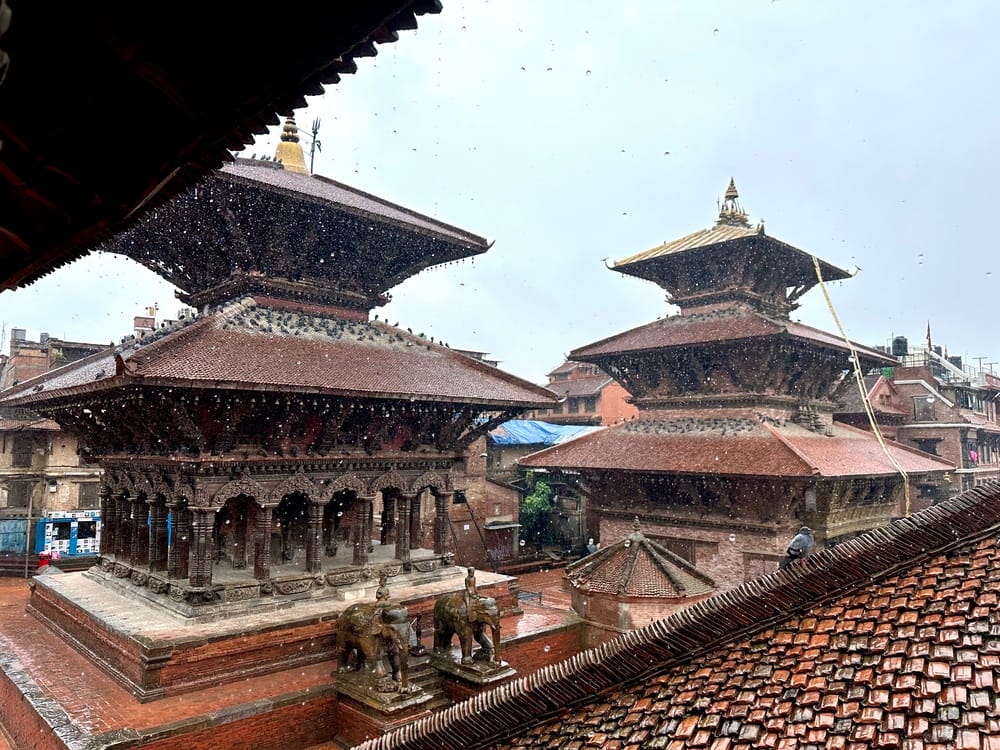
The Malla Kings and the golden age of temple building
Most of the erotic carvings visible today date from the Malla period, roughly between the 12th and 18th centuries.
The Malla kings ruled the Kathmandu Valley through a series of competing city-states centred on Kathmandu, Patan, and Bhaktapur. Competition between these kingdoms often took the form of monumental architecture rather than military conquest. If one king built a temple, another king wanted a bigger temple. If one city commissioned a beautifully carved palace, the neighbouring city responded with an even more elaborate one.
The result was an extraordinary flowering of art and architecture that transformed the valley into one of South Asia’s greatest urban cultural centres. Erotic carvings emerged within this environment of artistic experimentation and religious patronage.
Why were erotic images placed on temples?
The simple answer is that nobody knows with absolute certainty.
Several theories have been proposed:
Protection Against Evil Spirits
One of the most widely cited explanations suggests that erotic imagery functioned as a protective device. According to traditional beliefs, evil spirits approaching a temple would become distracted, confused, or embarrassed by explicit sexual imagery.
Whether demons are genuinely susceptible to awkwardness remains difficult to verify scientifically, but the explanation continues to circulate throughout Nepal.
Fertility and Prosperity
Another interpretation links the carvings to fertility. In Hindu traditions, fertility is often associated with prosperity, abundance, and cosmic creation. Sexual imagery can therefore symbolize the generative forces that sustain both society and the universe.
Rather than being scandalous, so called Kamasutra Temples may have represented positive and sacred concepts.
Tantric Influences
Perhaps the most convincing explanation involves Tantric religious traditions. Tantric Hinduism and Buddhism have played important roles in Nepal for centuries. Certain Tantric practices view the union of male and female energies as a symbolic representation of cosmic balance and spiritual enlightenment. Under this interpretation, the carvings represent metaphysical ideas rather than literal instructions for human behaviour.
Of course, this explanation is less exciting than “ancient temple sex manual”, which may explain why it receives less attention in travel brochures.
Education and Social Commentary
Some scholars argue that the carvings may have served educational functions in societies where formal sexual education was limited.
Others suggest they reflected the full spectrum of human existence. Temples were not necessarily intended to separate sacred and secular life as sharply as modern societies often do. Life included birth, death, worship, celebration, conflict, and sex. The carvings simply acknowledged reality rather than pretending otherwise.
Why are they mostly on the outside?
An interesting detail is that erotic carvings are usually found on exterior struts rather than within the temple’s inner sanctum.
Many scholars interpret it as representing the transition from worldly desires toward spiritual contemplation. Visitors pass by images associated with earthly existence before entering a sacred space focused on divine matters. The symbolism is subtle but consistent with broader Hindu and Buddhist architectural traditions.
It also means that visitors searching exclusively inside temples often miss the carvings entirely.
Colonial shock and modern tourism
When European travellers and colonial scholars first encountered South Asian erotic temple art, reactions ranged from fascination to outright horror. Victorian sensibilities were not particularly well equipped to process explicit carvings attached to active religious sites. Many early accounts described the sculptures as evidence of moral decline or cultural degeneration.
Today the situation has largely reversed. Modern tourists often seek out these carvings specifically because they seem unusual or provocative. The irony is difficult to miss.
Visiting Nepal’s Kamasutra Temples today
For travellers interested in seeing these Kamasutra Temples, the best approach is simply to explore Kathmandu Valley’s historic centres carefully. Bhaktapur Durbar Square remains arguably the best location due to the concentration of well-preserved Newar architecture. Patan and Kathmandu also offer numerous examples.
A knowledgeable local guide can be invaluable. Many carvings are small, positioned high above eye level, and easy to overlook. Visitors should remember that these are active religious sites rather than tourist attractions built around erotic art. Respectful behaviour remains important, even if some of the carvings occasionally provoke laughter.
What many tourists initially interpret as shocking or humorous was often understood very differently by the communities that created it. The carvings existed within religious, artistic, and social frameworks where sexuality was not automatically separated from spirituality, fertility, or cosmic symbolism.
They are also reminders that medieval Nepal was hardly the isolated Himalayan backwater that outsiders sometimes imagine. The Kathmandu Valley was a sophisticated cultural centre where artists, architects, religious scholars, and rulers produced works that continue to provoke discussion centuries later.
And yes, some of those discussions inevitably begin with someone staring at a temple roof support and asking, “Wait, is that really what I think it is?” Most of the time, the answer is yes.