
There are many memes on the internet, linking together Toyota Hiluxes and war in the Middle East and Africa. But is there any truth behind these jokes? There are many famous instances of Toyota Hiluxes being the car of choice during wars in the Middle East and Africa, but is there really a link between the two?
Table of Contents
Toyota Hiluxes and War – The Internet Link
For many years, the internet has been drawing attention to the link between Toyota hiluxes and war, specifically in the context of the Middle East and Africa. Did Toyota Hiluxes really become the ‘car of choice’ in guerilla warfare?
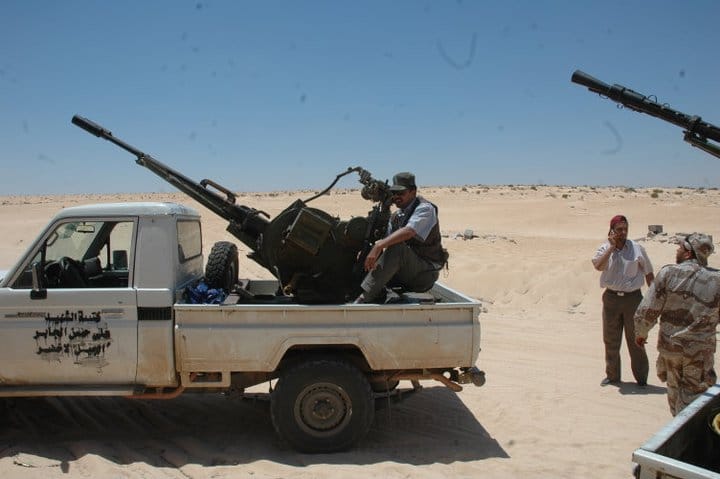
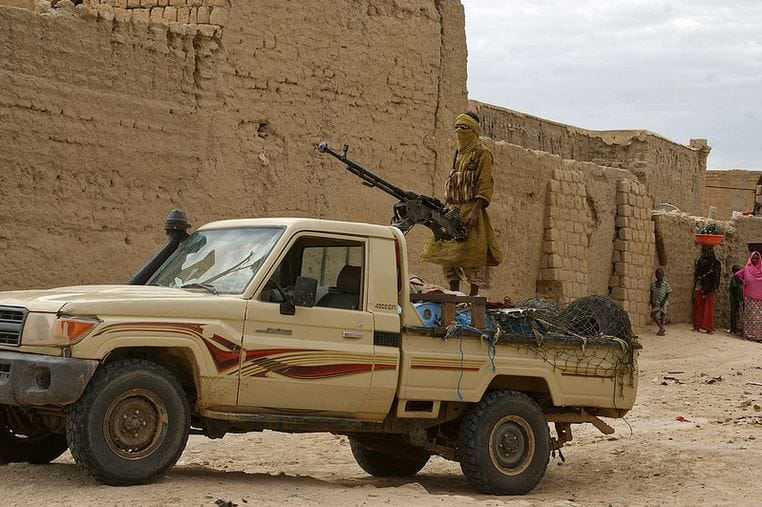
The military reputation of the Toyota Hilux, and Toyota trucks more broadly (particularly since the pickup version of the Toyota Land Cruiser is often mistaken for a Hilux), is well established. These vehicles are especially suited to conversion into “technicals”—military vehicles created by adapting civilian platforms for combat use. Their association with warfare became particularly famous in 1987 during the closing stages of the Chadian-Libyan conflict (1978–1987), a campaign often referred to as the Toyota War because of Chad’s highly effective use of Toyota Hilux and Toyota Land Cruiser pickups to transport and support infantry. For decades, Toyota trucks have also been widely used by armed forces across North Africa and other desert regions, including Afghanistan and Yemen.
The Historical Choice Of Vehicle
Toyota’s prominence among low-budget militaries can be traced back to the Korean War. During that conflict, the United States contracted Toyota to manufacture the Willys Jeep, partly because Toyota had already built a remarkably similar reverse-engineered vehicle during the Second World War known as the AK10. Significant factory resources and expertise had been devoted to producing these lightweight off-road vehicles, prompting Toyota to adapt the concept for civilian use after the war. Toyota viewed this civilian off-roader as an opportunity to compete directly with the British manufacturer Land Rover. To reinforce this image, the vehicle was named the Land Cruiser and promoted through publicity stunts such as driving to the summit of Mount Fuji. It quickly found popularity among Japanese emergency services, with police and fire-service variants entering production by the end of the 1950s. Although later Land Cruiser models gradually diverged from the Willys Jeep in appearance, they maintained an emphasis on mechanical simplicity and reliability. Since the Land Cruiser originated as a military vehicle, civilian versions have always been relatively easy to adapt back into military roles.
The Hilux followed a somewhat different path because it was not originally designed with military applications in mind. When introduced in 1968, the model struggled initially and underwent several substantial redesigns, some of which even abandoned the Hilux name in an effort to reinvent the vehicle. However, Toyota had already developed a reputation for producing rugged vehicles with military potential, and the Hilux increasingly became the alternative when Land Cruisers were unavailable or too expensive. Toyota itself encouraged this transition by gradually making the Hilux resemble the pickup variant of the Land Cruiser. By the late 1970s, the Hilux had effectively become a smaller, more affordable version of the Land Cruiser pickup. Its low cost, durability, and ease of maintenance made it highly successful in regions with poor infrastructure, particularly throughout Africa and the Middle East.
Other Models With Similar Reputations
Land Rover once occupied a similar position. During many low-budget conflicts of the 1960s and early 1970s, modified Land Rovers were common military vehicles. However, this changed when Land Rover experienced significant manufacturing and quality-control problems beginning in the late 1970s and continuing through much of the 1980s. Owners of vehicles from that period can attest to their reliability issues. As confidence in Land Rover declined, the Hilux gained favor among militaries that had previously relied on modified Land Rovers. By contrast, 1980s-era Hiluxes earned a reputation for near-indestructibility, becoming the automotive equivalent of the AK-47. This image was famously reinforced in 2006 when the British television show Top Gear subjected a 1988 Hilux to a series of extreme challenges that it largely survived.
Reliability of Toyota Hiluxes And Wartime Usage
While many manufacturers have produced off-road vehicles comparable to the Hilux and Land Cruiser, few have achieved Toyota’s reputation for reliability in harsh environments. Companies such as Ford and Nissan have sold trucks throughout Africa and the Middle East—the Ford Ranger, for example, is also commonly converted into technicals—but these vehicles are primarily designed for North American conditions and generally perform less effectively in deep sand. In desert environments, the Hilux dominates. Competing vehicles suitable for conversion must contend with Toyota’s established reputation. Turning a Toyota into a technical is a proven formula; converting less common alternatives introduces uncertainty. As a result, when underfunded militaries need light vehicles quickly, the Hilux is usually both the most readily available option and the one most familiar to military mechanics and engineers.
Not Just War – Built For Tough Conditions
Toyota’s success is not solely due to producing reliable trucks with military ancestry. The company has also consistently designed vehicles that can be adapted to a wide variety of purposes. This remains true today. Both the Hilux and Land Cruiser have been used in Arctic and Antarctic expeditions, as camera platforms, and by emergency services around the world. Their versatility makes the installation of military hardware relatively straightforward without significantly compromising performance or reliability. Heavy machine guns, anti-aircraft weapons, anti-tank missiles, grenade launchers, and numerous other systems can be mounted on the flatbed with minimal modification.
The Toyota War (1987) Between Chad and Libya
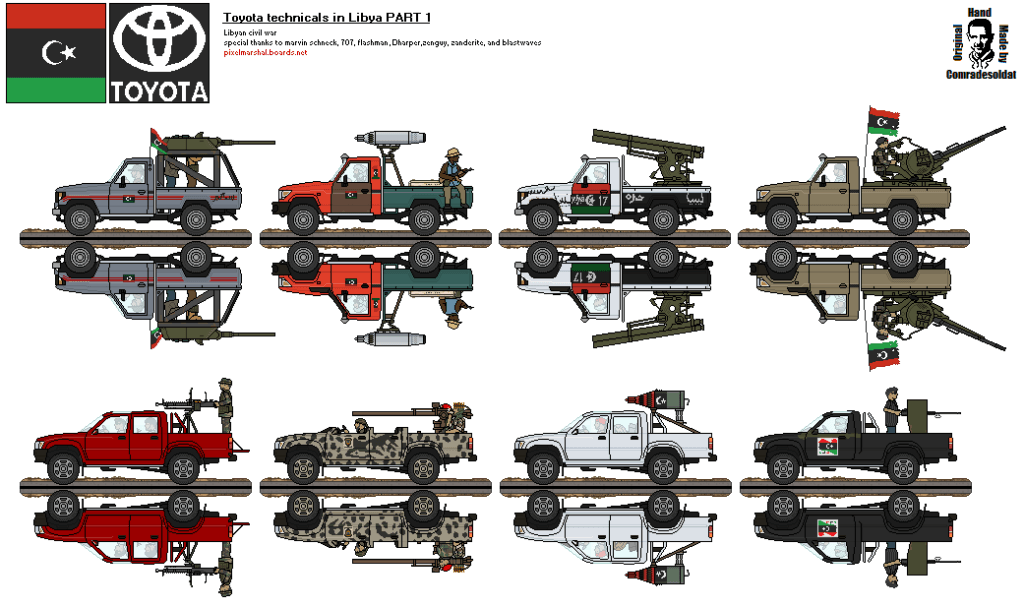
The combined impact of these qualities was demonstrated dramatically in 1987 during the Toyota War, the final phase of the Chadian-Libyan conflict. After Hissène Habré became Chad’s leader in 1983, Muammar Gaddafi backed a rebel movement known as the Transitional Government of National Unity (GUNT) and occupied northern Chad. Relations between Gaddafi and GUNT deteriorated, and the group rebelled against Libya in 1986. Habré seized the opportunity to launch a new offensive against Libyan forces in the north. However, the sudden nature of the conflict required Chad to mechanize its military rapidly. Rather than depend on French or American vehicles that would require extensive training, Chad converted Toyota Land Cruisers and Hiluxes into technicals equipped with Western anti-tank weapons.
These vehicles were deployed against Libya’s Soviet-supplied T-55 and T-62 tanks. The outcome at the Battle of Fada was disastrous for Libya. The tanks struggled to engage the fast-moving, compact Toyota vehicles, making accurate fire extremely difficult. At the same time, their armor proved vulnerable to the MILAN anti-tank missiles mounted on many of the technicals. Chad lost only three Toyotas during the battle, while Libyan forces lost nearly one hundred tanks. Columns of technicals could strike deep behind enemy lines and withdraw before heavier armored units could respond, while also providing effective support to infantry in conventional engagements.
Although Libya eventually adapted and achieved some successes before the war ended, the Battle of Fada had a lasting influence. By the conflict’s conclusion, the reputation of the Hilux had become virtually unrivaled. In open desert warfare against opponents lacking air superiority, the logic seemed compelling: why purchase a tank when the same resources could produce a dozen Toyota technicals? Fada marked the first major conflict in which technicals formed the core of a military force, and its outcome shaped regional military thinking about light mobile warfare for decades afterward.
Toyota Hiluxes and War In Syria – How ISIS Ended Up With Brand New Trucks
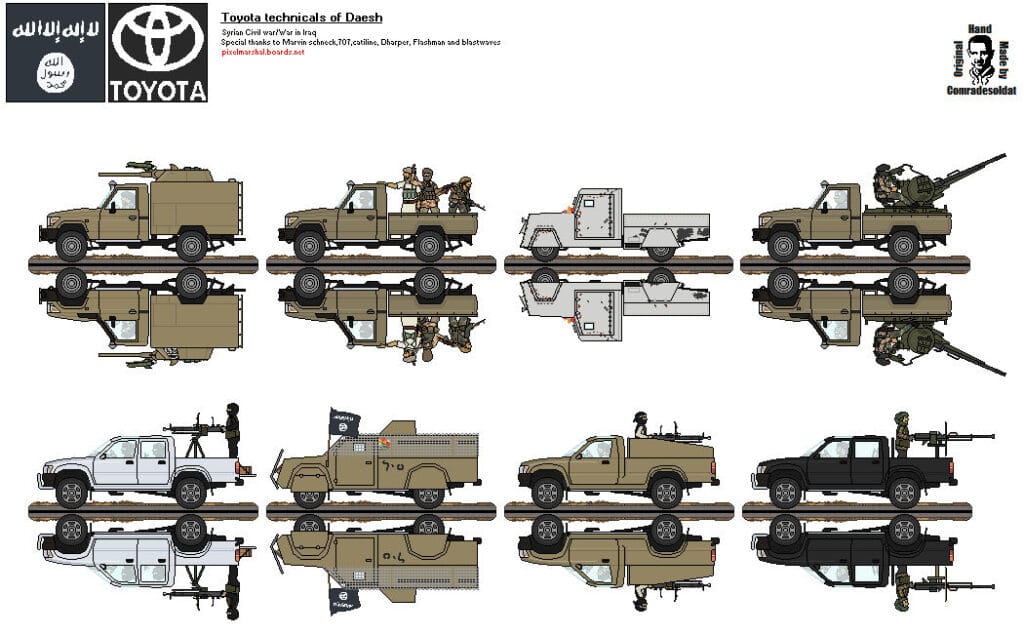
Many brand new Toyota trucks ended up in the hands of Daesh (ISIS) in 2014-2017 in Syria and Iraq. ISIS often showed off their battalions of Hiluxes in their propaganda videos posted to social media. U.S. officials investigated how hundreds of brand-new Toyotas ended up in the hands of the militant group. Toyota stated they have a strict policy not to sell vehicles to paramilitaries or terrorists, but explained it is impossible to control indirect, gray-market, or black-market sales
What Does Toyota Think About This Link?
Toyota itself does not market vehicles directly to armed forces and has publicly expressed discomfort with the Hilux’s association with warfare. Nevertheless, the company has little control over the vast global second-hand market. Toyota Hiluxes and war are linked, despite the negative press Toyota would like to avoid.
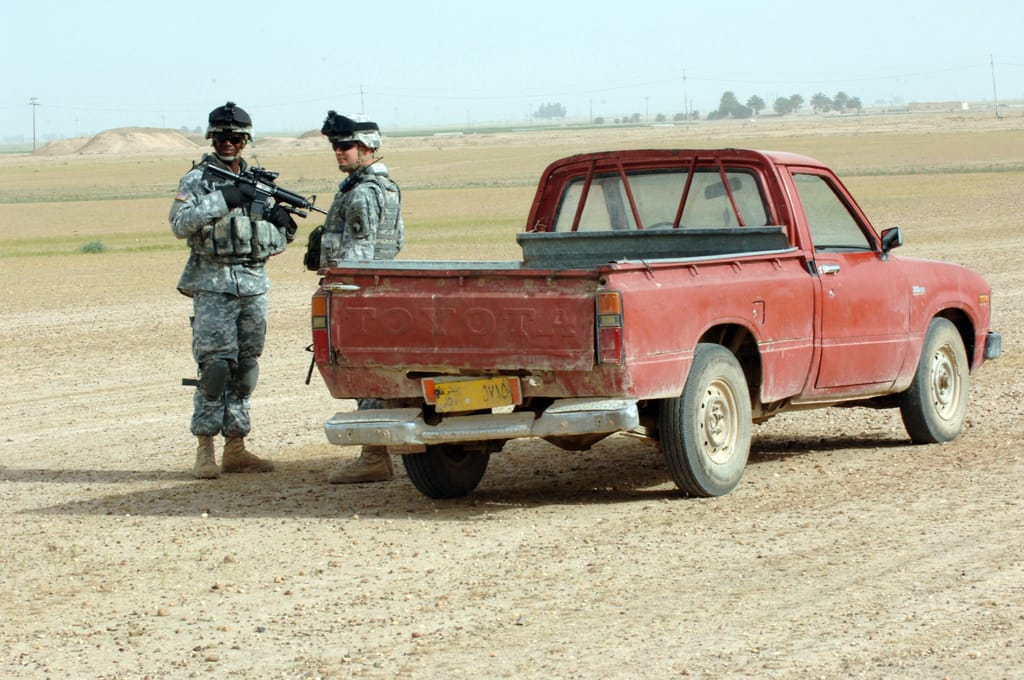
Toyota Hiluxes and War
The Toyota Hilux became the preferred platform for technicals for several interconnected reasons. Toyota’s trucks evolved from vehicles with military roots dating back to the Korean War and maintained a reputation for reliability and mechanical simplicity even as competitors such as Land Rover experienced periods of decline. Combined with low cost, widespread civilian availability, and exceptional ease of modification, the Hilux emerged as the natural choice for improvised military vehicles among budget-conscious forces operating in demanding environments.