Thinking Southeast Asia is not a typical YPT destination? Well, think again.

While Southeast Asia has become a popular backpacker route over the years, there is another side of the region that is much more our style. Some of the heaviest fighting in modern history happened here just a few decades ago. Behind the picturesque beaches, temples, and cities is a huge amount of war history waiting to be explored.
Because much of this history is so recent, many of the people who lived through it are still around today. We work closely with war survivors and veterans who share their experiences and guide us through the places where history happened.
No guidebook can recreate the feeling of hearing these stories firsthand from someone who witnessed these events themselves.
Here are some of the survivors and veterans we met on our previous tour.
Table of Contents
Mr. Borint – Growing Up During the Khmer Rouge
Our first stop in Cambodia was the War Museum in Siem Reap.
With us was Mr. Borint, a survivor of the Khmer Rouge regime. Between 1975 and 1979, the Khmer Rouge, led by Pol Pot, ruled Cambodia under a brutal communist system. Around two million people died from executions, forced labour and starvation.
Mr. Borint was only a young boy when it happened, but he remembers those years clearly. He and his family were constantly hungry. He could not call his parents “mom” and “dad”. Instead, they had to be referred to as “comrades”. Every movement was watched, and daily life was controlled by the regime.
One day, his older brother was caught digging for roots to eat. The soldiers took him away for a “meeting”, but Mr. Borint never saw him again.
Today, he welcomes our questions with a smile and is happy to share his story with the group. But as he says:
“My face is smiling, but my heart is not.”
We asked if his children, who are now around the same age he was during the Khmer Rouge period, know his story.
“They know a little bit, but I don’t tell them too much. I don’t want to make them sad.”

Norng Chanphal and Norng Chanly – Survivors of S-21
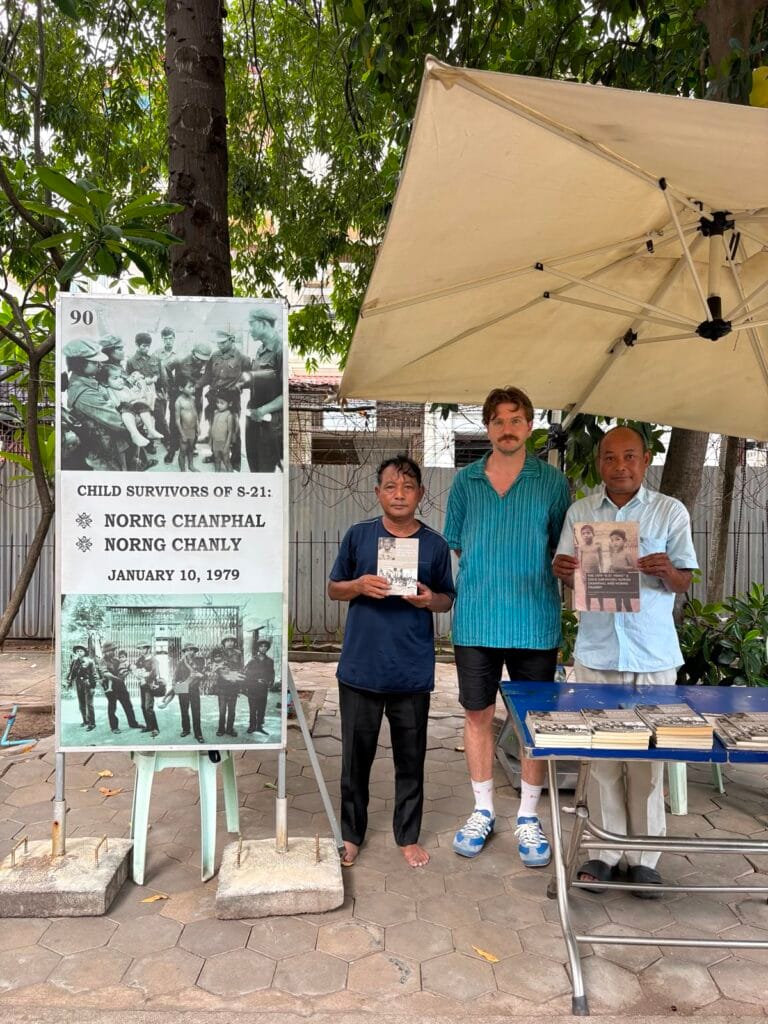
At S-21 Prison in Phnom Penh, we met Norng Chanphal and Norng Chanly, two survivors of one of the darkest chapters in Cambodia’s history.
During the Khmer Rouge regime, S-21, now known as the Tuol Sleng Genocide Museum, was used as a secret prison and interrogation centre. Around 17,000 people were imprisoned here, and almost all were killed. Only a small number survived.
Norng Chanphal was just a child when he was imprisoned at S-21. He survived because he was forced to work inside the prison repairing equipment for the Khmer Rouge. Many of his family members were killed during the regime.
Norng Chanly was also imprisoned at S-21 as a young boy. Like many victims of the Khmer Rouge, his childhood was taken away by the brutality of the regime.
Today, both survivors return to S-21 to share their stories with visitors, giving us a rare chance to hear firsthand from people who lived through these events.
The children in the “Napalm Girl Photo” in Vietnam
Crossing the Cambodia-Vietnam border, we stopped at Trảng Bàng village, the location where the famous “Napalm Girl” photograph was taken.
After learning about the Khmer Rouge, it was time to explore another tragic chapter of Southeast Asian history: the Vietnam War.
We drove along the same highway where the photograph was captured. Today, the road looks completely different from the war-torn images that became known around the world.
At the end of this highway is a small coffee shop owned by the son of one of the boys in the famous photograph.
If you are lucky, you might meet him, or even some of the people from the photo who are still seen around the coffee shop today. We were lucky and met one of the women photographed that day.

Despite the language barrier, we shared a meaningful moment with a survivor of one of the most devastating attacks of the Vietnam War. Next to the cafe is the temple where the children ran for shelter during the bombing.

Mr. Hai – Growing Up During the Vietnam War
After exploring Ho Chi Minh City, including the Cu Chi Tunnels, War Remnants Museum, and former CIA building, we continued our journey to Nha Trang.
Here we met Mr. Hai, whose family story is closely connected to the Vietnam War. His family originally came from North Vietnam, but as Catholics, they moved south after the communist government took control in 1954.
Mr. Hai shared memories of growing up during the war and how it shaped his childhood.
During our meeting, one of the Americans in our group gave him a small American flag pin and a cross pin as a gift. Mr. Hai’s eyes immediately lit up.
“This reminds me of when the American soldiers came to my village and handed out small sweets from their pockets to me. I remember feeling safe.”

Mr. Trung – In Charge of the Troops Fighting for His Country
In Hue, we met Mr. Trung, a true war veteran.

Today, he is an older man, but he still guides tours to the former DMZ, the same area where he once fought during the Vietnam War.
Mr. Trung was in charge of several troops fighting for South Vietnam in this region. Now, decades later, he brings visitors through the former battlefields and shares his personal experiences.
He takes us through the DMZ, visiting important sites such as Khe Sanh Combat Base, the Ho Chi Minh trail, the Ben Hai River and Hien Luong Bridge, and the Vinh Moc Tunnels.

At Khe Sanh Combat Base, Mr. Trung points towards one of the old military aircraft on display.
“I used to fly around in one of these with my team.”

Mr. Kong – The Secret War in Laos
After a long journey through Vietnam and learning about the Vietnam War, we crossed into Laos, a country with one of the most tragic war histories in the world.
Laos is the most heavily bombed country in history. More than two million tons of bombs were dropped on the country over nine years, with bombing taking place every eight minutes.
Here we met Mr. Kong, a veteran who fought around Long Tieng, our next destination.
As he shares his story, he opens his shirt and shows us his shoulder. A large scar is still visible. He then turns around, showing the exit wound where the bullet passed through his body.
The bullet came from a communist North Vietnamese soldier during the fighting in Laos.
Decades later, Mr. Kong’s story gives us a rare personal connection to the often-forgotten Secret War in Laos.

Meeting these survivors and veterans is what makes a YPT tour different. Beyond the museums and battlefields, we get the rare chance to hear history directly from the people who lived through it.
From the Khmer Rouge in Cambodia, to the Vietnam War, and the Secret War in Laos, these personal stories bring the past to life in a way no textbook can.
Interested in joining our next adventure? Get in touch!